A career coach helps you decide what’s next and make the move: stay, leave, pivot or step back. An executive coach helps you lead better in the role you already have. If your real question is whether you should be in this role at all, start with a career coach. If the question is how to lead where you are, start with an executive coach.
I’m a coach who does both kinds of work, so you’d expect me to blur the line. I reckon the honest answer is kinda sharper than that. Here’s how I tell them apart, who each is for, and how to choose before you pay anyone.
Who this comparison is for
I’m writing for mid-career professionals and leaders, often in their 40s or 50s, who are good at what they do and keep googling coach types because the decision feels expensive and a bit confusing.
If you mainly need a sharper resume or interview practice, you probably don’t need either kind of coach yet. A resume service will usually do it for less. The Australian Government’s free Your Career website covers career options, resumes and interviews. If you live in NSW, you can book a free Careers NSW appointment with a careers practitioner (18 or over, citizen or permanent resident).
Career coach vs executive coach in plain English
They answer different questions.
A career coach works on direction and transition. Stay or go. Same industry or a pivot. What the next chapter should be about. Then the outer moves: positioning, CV, conversations, timing.
An executive coach works on how you lead in the seat you have. Presence, decisions, stakeholders, pressure, the lonely bits at the top. The Suit stays. The work is how you wear it.
I’ve written honest takes on whether a career coach is worth it and on whether executive coaching is worth it. This piece is the side-by-side, so you stop buying the wrong one.
Career coaching asks what next. Executive coaching asks how you lead here.
The coach I needed in 2008
In my twenties I worked in Shenzhen in South China on a Hong Kong contract. Within two years I was one of the top sales performers in the region. From the outside, it looked like the career I’d been aiming for.
Then, in 2008, just before the financial crisis, I was fired. I sat in a coffee shop in Hong Kong, half relieved and half terrified. The job was gone. The title was gone. I walked to the beach and asked myself what I actually wanted. I had no idea.
An executive coach wouldn’t have been the right hire that week. I wasn’t trying to lead better in a role I no longer had. I needed someone to ask who I was without the title, then help me build a move around the answer.
That was my wake-up call. I started my own business in 2010 and ran a training business in China for eight years, from 2010 to 2018, and 2011 was a real turning point on the inside. Across 20+ years in global business and more than 5,000 hours of coaching leaders, I’ve found that first question still decides which coach to hire.
I didn’t need to lead better that week. I needed to know who I was without the title.
When to hire a career coach
- You’re circling a real decision. Stay, leave, pivot, step back, or go out on your own, and you’ve been circling it for months.
- You’re successful but restless. The title and salary are right, and something still feels off.
- Change has been forced on you. A redundancy can be a shock and an opening. I work with leaders facing redundancy in Sydney on exactly this.
- You’re ready to look at yourself, not just the job market.
That’s the heart of my career transition coaching: clear the inside first, then build the outer move so it holds.
When to hire an executive coach
- You’re staying, and the hard part is how you lead: a bigger seat, a difficult board, a team that needs you sharper.
- You’ve been promoted into a role that asks for a different version of you, and the old habits are getting loud.
- You’re willing to look at yourself, not just your strategy, your boss or your team.
- You can protect the time. An hour or two every couple of weeks, plus the thinking in between.
If your employer is paying, expect the focus to stay on success inside that organisation. That’s useful. It is rarely the right setting to plan your exit.
Wrong coach, same Gap
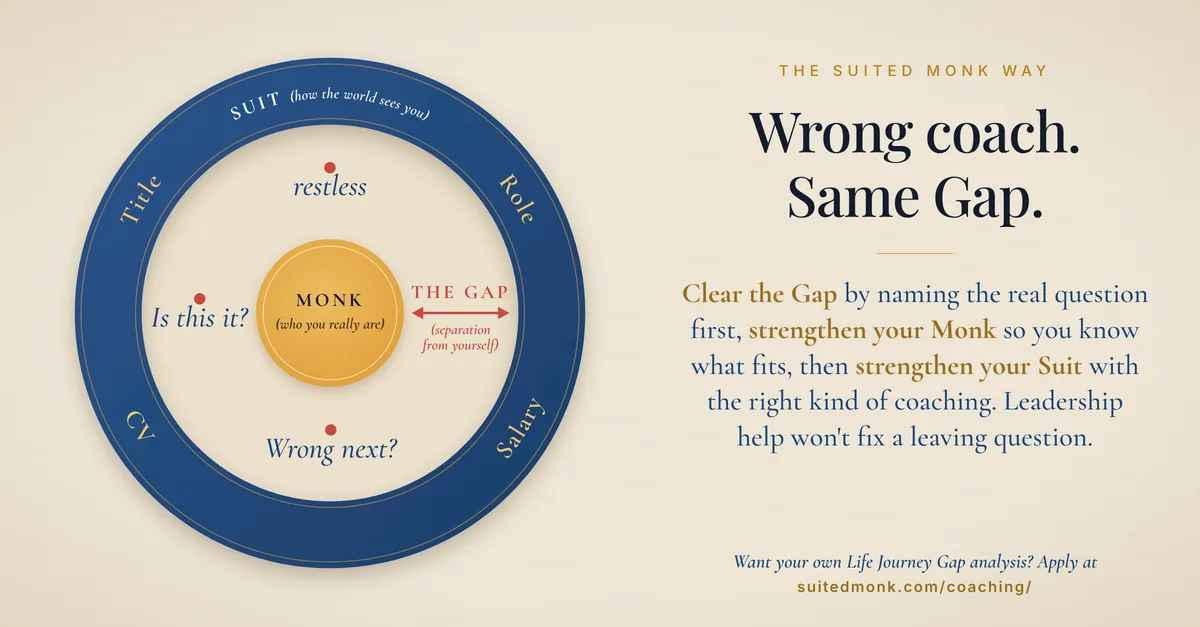
In The Suited Monk philosophy by Raf Adams, the Suit is your outer life: role, title, salary, the CV. The Monk is your inner life: your values, your purpose, who you are when nobody is grading you. The distance between them is the Gap.
The Suit is a good thing. The problem is the Gap. Hire an executive coach when the Gap is about how you lead in a role you’ve chosen to keep. Hire a career coach when the Gap is about whether that role still fits who you are.
Here’s a pattern I see often (a composite, not one person). A leader hires an executive coach to get better at a job they already want to leave. Six months later they’re sharper in meetings and still restless on Sunday night. The coaching worked. It answered the wrong question.
If the Gap is about leaving, leadership coaching just makes the wrong Suit fit better.
What each one usually costs
I won’t invent market averages. Prices vary and many coaches don’t publish theirs, so ask. One honest reference point is my own prices, in US dollars, as listed on my coaching page and Life Audit page:
- The online Life Audit: free.
- Life Audit Debrief: US$297 for a 45-minute private call.
- One Life Journey Session: US$497 for a single 1:1 session.
- The Life Journey Program: US$3,500 for three months and six private 1:1 sessions.
- Private coaching: US$15,000 for six months and twelve private 1:1 sessions.
Worth isn’t only the invoice. What is another year of answering the wrong coaching question costing you?

A simple way to choose
- Write the question in one sentence. Stay or go? Lead better here? Both?
- See where the Gap is. The free online Life Audit takes about 3 minutes. You answer 35 short statements and get your Suit, Monk and Gap scores by email.
- Match the coach to the question. Leaving and direction = career coach. Leading in a role you’re keeping = executive coach.
- Talk to two or three people. Notice who you’d actually be honest with. Ask who they usually work with and what training they hold.
- Agree a time frame. Three months is long enough to see whether something is shifting.
If the move is a later-career change, see how I work as a career change coach in Sydney.
Frequently asked questions
Career coach vs executive coach: what’s the difference?
A career coach helps you decide what’s next and make the move: stay, leave, pivot or step back. An executive coach helps you lead better in the role you already have. If your real question is whether you should be in this role at all, start with a career coach. If the question is how to lead where you are, start with an executive coach.
Do I need a career coach or an executive coach?
Write the question in one sentence. “Should I leave this year?” points to a career coach. “How do I lead this team without burning out?” points to an executive coach. If both are true, start with the leaving question first, because leadership work on a role you plan to quit rarely sticks.
Can I work with both a career coach and an executive coach?
Yes, and many leaders do over a career. Just don’t hire two coaches for the same question at once. Clear goals for each engagement, and be honest about who is paying. Employer-funded executive coaching usually stays focused on success inside that organisation, which is the wrong room to plan an exit.
How much does executive coaching cost?
Prices vary a lot and many coaches don’t publish them, so ask before you book. As one reference point, Raf Adams publishes his prices in US dollars: US$497 for a single 1:1 Life Journey Session, US$3,500 for the three-month Life Journey Program and US$15,000 for six months of private coaching. The online Life Audit is free.
A starting point
You don’t have to hire anyone today. Start by getting honest about which question you’re really asking. If you want help after that, it’s exactly what my 1:1 coaching is for.
Your Suit got you here. I reckon the next hire is worth matching to who you really are, not to the label on the coach’s website.