A midlife career crisis is the restless “is this it?” feeling that hits many leaders in their 40s or 50s, when the career that once fitted no longer matches who they’ve become. It isn’t a breakdown or a failure, and it doesn’t mean you have to change everything tomorrow. The best move is to slow down, work out what the restlessness is really about, and then reshape your path from a clear head rather than in a panic.
Leaders rarely call it a crisis out loud. They say things like “I’ve done everything right, so why do I feel like this?” If that sounds familiar, you’re not broken, and you’re definitely not alone.
Who this is for
I’m writing for executives, senior managers, founders and business owners, often in their 40s or 50s, who look successful from the outside. You’ve got the title, the experience and a decent salary. But something has shifted inside, and the career that used to energise you now feels like a role you’re playing.
If you’re in crisis or thinking about harming yourself, please stop reading and call Triple Zero (000) or Lifeline on 13 11 14, any time.
What a midlife career crisis actually is
It’s not a sports car or a sudden resignation. For most leaders it’s a slow build of restlessness, a growing distance between the person you’ve become and the life you’re living.
Associate Professor Priscilla Dunk-West, a sociologist from Charles Darwin University, told ABC Everyday that the mid-life crisis is real, and that it isn’t selfish: “It reflects someone who’s connected with who they are and what they want to do in their lives.”
I agree. The restlessness isn’t the problem. It’s a message.
Signs you might be in one
- Work you used to enjoy now feels flat, even when it goes well.
- You hit a big goal and felt relief instead of pride.
- Sunday evenings carry a low hum of dread.
- You catch yourself envying people who changed paths.
- Your title no longer feels like it describes who you are.
- The same question keeps coming back: is this it?
A health note before we go on. If your mood is low most days, or your sleep, appetite or energy has changed and isn’t bouncing back, see your GP first. That’s not a career problem to solve on your own.
Why it hits leaders hardest
When your career is going badly, the answer can look obvious. When it’s going well, there’s nothing obvious to blame. The pay is good, the title is senior, and you feel ungrateful for even asking the question.
That’s why so many leaders feel stuck in their career even though they’re successful, and why plenty of others stay put when they hate the job but it pays well. Seniority and golden handcuffs make the crisis easier to hide, not easier to solve.
The restlessness isn’t the problem. It’s a message.
Mine came early
I arrived in South China in 2006, aged 27, working in freight forwarding in Shenzhen on a Hong Kong contract. I threw myself at the Suit: title, results, money, how I looked to the people around me.
Then in 2008, just before the financial crisis hit, I lost my job. I sat in a coffee shop in Hong Kong, half relieved and half terrified. The job was gone. The title was gone. I walked to the beach and asked myself what I actually wanted, and I had no idea.
It was a career transition I hadn’t planned, and it was my wake-up call. I reckon the age matters less than the moment your career stops covering what’s underneath. Mine came before I turned 30. For most of the leaders I coach, it comes later, often when the outside looks better than ever.
I started my own business in 2010, and 2011 was a real turning point on the inside. I’ve since spent 14 years running my own training business in China and Spain, and now I coach leaders from Sydney.
The Gap behind the crisis
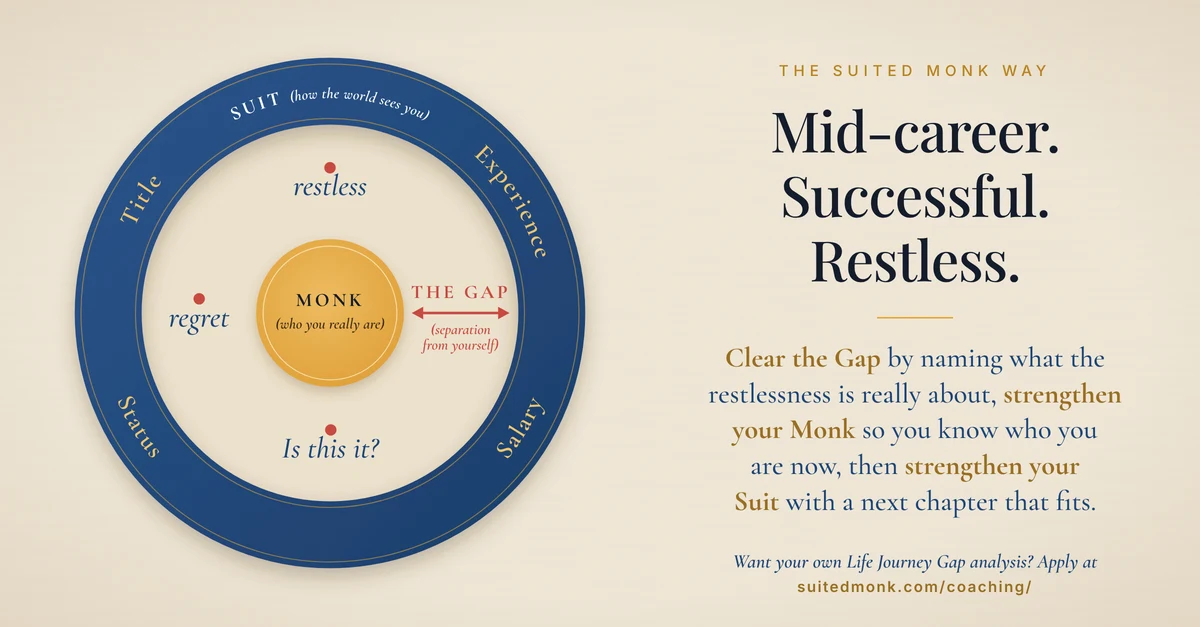
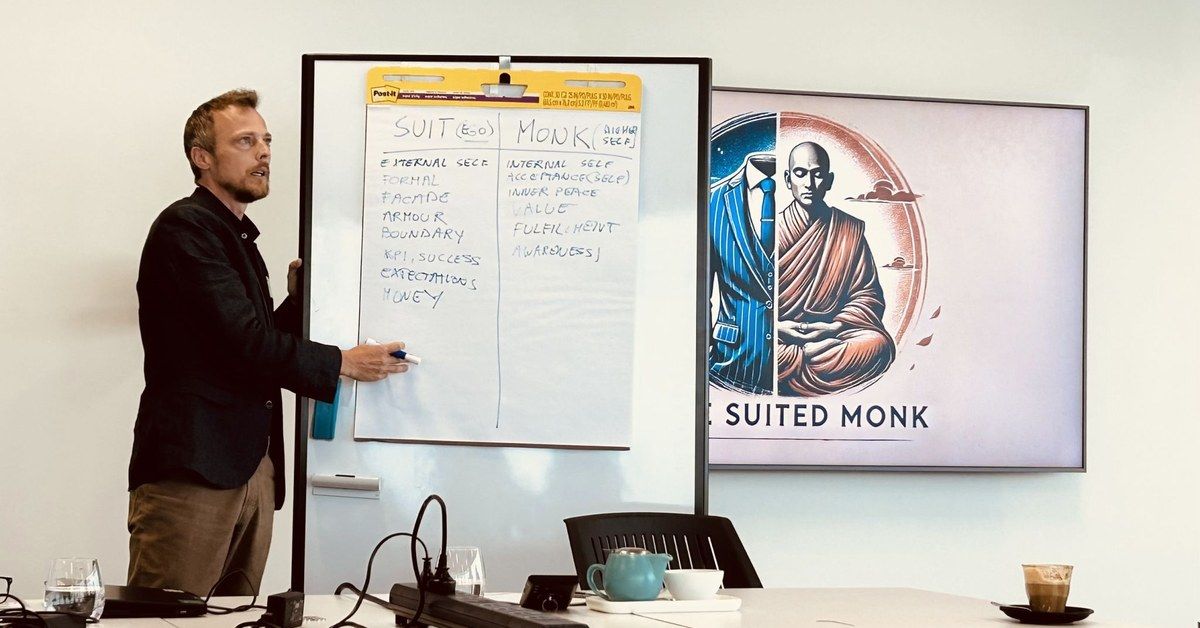
In The Suited Monk philosophy by Raf Adams, the Suit is your outer life: title, experience, salary, status. The Monk is your inner life: your values, your purpose, who you are when nobody’s watching. The distance between them is the Gap.
In your 20s and 30s, a busy career can cover a wide Gap for years. By midlife, the Gap has had time to fill up with regrets, unfinished conversations and the nagging suspicion that you built a life to impress other people. That’s usually what a midlife career crisis really is: the Gap getting loud enough to hear.
The path I use has three steps, in this order. Clean the Gap: name what you’re carrying and deal with it. Grow your Monk: get clear on who you are now, not who you were at 25. Maximise your Suit: then shape your next career move around that. Happiness tends to follow inner peace, not the other way round, which I explain in from happiness to inner peace.
What to do about it in 2027
Heading into 2027, AI and restructures are making a lot of leaders in their 40s and 50s look harder at the next 20 working years. That pressure is real, but it’s a reason to think clearly, not to rush.
- Don’t make the big call in the first wave. Decisions made from frustration often swap one problem for another. Give yourself a few weeks of honest reflection before you change anything big.
- Work out what’s actually restless. If the same role at a different company would fix it, you need a new job. If the work itself no longer fits who you are, it may be time for a new career. If it’s bigger than work, start there.
- Write down what matters now. Your values at 45 probably aren’t the ones you had at 25. Three things you want more of, and three you’re done with, is a good start.
- Test before you leap. You don’t have to overhaul your life to test a direction. Have conversations with people doing the work you’re curious about, take a short course, or try a small project on the side. Small experiments beat big guesses.
- Get the right support. A good friend helps. A coach helps you turn the restlessness into a plan. If a bigger move is on the cards, read my guide to changing careers at 45, or see how career transition coaching works with me.

Kinda counterintuitive, but the people who handle this best are rarely the ones who move fastest. They’re the ones who get clear first.
Frequently asked questions
What is a midlife career crisis?
A midlife career crisis is the restless “is this it?” feeling that hits many leaders in their 40s or 50s, when the career that once fitted no longer matches who they’ve become. It isn’t a breakdown or a failure, and it doesn’t mean you have to change everything tomorrow. The best move is to slow down, work out what the restlessness is really about, and then reshape your path from a clear head rather than in a panic.
Is a midlife career crisis only about work?
No. The job is often where you notice it, because that’s where so much of a leader’s identity has been built. Underneath, it’s usually about your life: who you are without the title, whether your days still have meaning, the Gap between your outer and inner life, and what you want next as a person, including in your relationships. The career question is real, but it’s rarely the whole story.
What are the symptoms of a midlife career crisis?
The common ones show up in your life, not only at work: a sense that your title no longer says who you are, Sunday night dread, envy of people who changed paths, a growing distance in relationships, and the same question coming back again and again: is this it? If your mood, sleep or energy has dropped and stayed down for weeks, see your GP as well.
Can a midlife crisis be a good thing?
Yes, if you use it well. It’s often the first time in years you’ve stopped to ask what you actually want from your life, not only from your career. Handled calmly, it can lead to more inner peace and a life that fits who you are now, not who you were at 25.
A starting point
If you’re in the middle of this, start by seeing where your Gap is. The free online Life Audit takes about 3 minutes: 35 short statements, and you get your Suit, Monk and Gap scores by email.
A midlife career crisis can be the end of a chapter that no longer fits, and the start of one that does. You don’t need to have it all figured out today. You just need to stop ignoring the message.