Executive coaching is worth it when you’re ready to look at yourself, not just your results, and you choose a coach you trust with clear goals and a set time frame. It’s rarely worth it if you want someone to fix your team, your boss or your mood for you. The real return is a leader who decides from who they are, not from external validation.
I’m an executive coach, so you’d expect me to say yes. Fair enough. I reckon the more useful answer is “it depends”, and then being honest about what it depends on. That’s what this article is.
Why so many leaders are sceptical
Most leaders asking this aren’t asking about coaching in general. They’re asking about themselves.
Something feels off. HR has suggested a coach, or a mate swears by theirs. Then you see the price and think, hang on.
That scepticism is healthy. Some coaching changes how a person leads and lives. Some is a nice chat with a bill at the end.
What executive coaching actually is (and isn’t)
Executive coaching is a series of private, one-to-one conversations about how you lead and how you live. It isn’t therapy, it isn’t consulting, and it isn’t a training course.
A good coach listens far more than they talk and asks the questions you’ve been avoiding. You do the thinking. That’s kinda the whole point.
Some coaches stick to performance at work. Others look at the whole picture, which is closer to my work as a life coach for executives in Sydney.
What I would have needed at 27
I arrived in South China in 2006. I was 27, working in freight forwarding, and two years later I was one of the top sales performers in the region.
Everyone was happy about my results, except me. I’d feel good for a little while after a win, then something would gnaw at me. A loneliness that didn’t make sense. A low, heavy feeling I couldn’t name. So I’d go looking for something outside me to feel okay again. More pleasure. More external validation.
If someone had offered me a coach back then to hit bigger numbers, I reckon it would’ve been money down the drain. I didn’t need more Suit. I needed someone to ask me who I was without it.
In 2008 I lost that job, and the question asked itself. It’s the same question I now ask leaders every week. After 5,000+ hours of coaching leaders, I reckon it’s often the one that matters most.
I didn’t need a bigger Suit. I needed someone to ask me who I was without it.
When executive coaching is worth it
Coaching tends to pay off when a few things are true.
- You’re successful, but it feels flat. The wins keep coming and the good feeling fades faster each time. If that sounds like you, read why you can feel stuck in your career even though you’re successful.
- You’re facing a transition. A bigger role, a redundancy, a career change, or the end of a chapter you built your identity around.
- You’re willing to look at yourself. Not just your team, your strategy or your boss. You.
- You can protect the time. An hour or two every couple of weeks, plus the thinking in between.
When it’s not worth it (yet)
- You want someone to fix other people. A coach can help you lead a difficult team. A coach can’t change your team for you.
- You’ve been sent and you don’t want to be there. Coaching you resent rarely moves anything.
- You want answers handed to you. That’s a consultant or a mentor, and both can be great.
- You’re in crisis or unwell. If you’re exhausted all the time, can’t switch off, or feel hopeless, please talk to your GP or a psychologist first. Many employers also offer a free, confidential Employee Assistance Program. Alongside that care, I work with leaders as an executive burnout coach.
Coaching is worth it when you’re ready to change you. It’s rarely worth it when you want it to change everyone else.
Why some coaching changes nothing
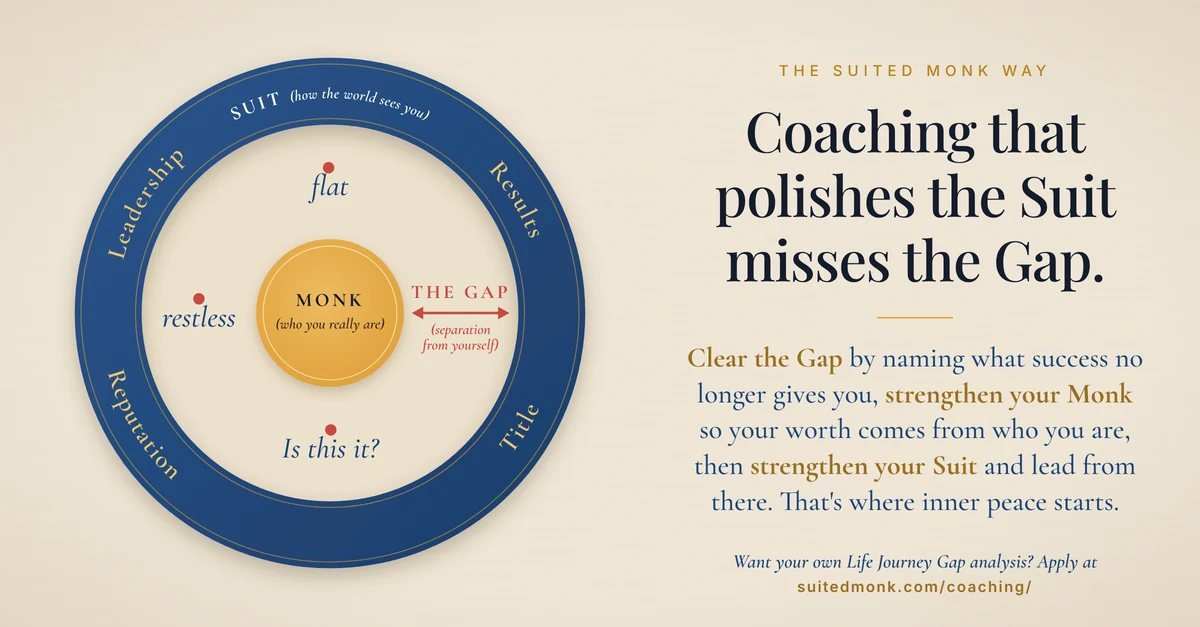
The Suit is your outer life: role, results, reputation, income. The Suit is a good thing. You worked hard for it. The Monk is your inner life: your values, your purpose, who you are when nobody is grading you.
The problem isn’t the Suit. The problem is the Gap between the Suit and the Monk. When that Gap is wide, it fills up with stuff. That flat feeling after a promotion. Restlessness on a Sunday night. A voice asking, is this it?
A lot of coaching polishes the Suit: better presence, sharper strategy, more influence. All useful. But if the real issue is the Gap, a shinier Suit won’t close it. You’ll just be more impressive and feel the same.
In The Suited Monk philosophy by Raf Adams, the work goes in an order: clear the Gap, strengthen the Monk, then strengthen the Suit. Worth comes from being, not doing. When a leader is at peace with who they are, decisions get simpler and the Suit starts working for them instead of the other way round.
How to tell if a coach is right for you
Most coaches offer a free first call. Here’s what I’d ask in it.
- Who do you usually work with, and on what? You want someone who gets the weight of senior roles.
- What does a typical session look like? Listen for a clear approach in plain words.
- How will we both know it’s working? Good coaches agree on what should feel or look different, and check it along the way.
- What training and credentials do you hold? The International Coaching Federation, for example, has three credential levels (ACC, PCC and MCC), each needing set hours of coach education and coaching experience (ICF).
Red flags: guarantees of promotions or income, pressure to sign before you’ve had time to think, a coach who talks more than they listen in that first call, or one who tells you what your life should look like.

What does executive coaching cost?
I won’t quote you market averages. Prices vary hugely and plenty of coaches don’t publish theirs, so ask up front. What I can give you is one honest reference point: my own prices, in US dollars, as listed on my executive coaching page.
- The free Life Audit to see where you stand before you commit to anything.
- One 1:1 Life Journey Session: US$497.
- The Life Journey Program: US$3,500 for three months and six private 1:1 sessions.
- Private Coaching: US$15,000 for six months and twelve private 1:1 sessions.
But worth isn’t really about the invoice. A better question is what staying the same is costing you: your sleep, your health, your relationships, the decisions you keep putting off.
On tax in Australia, I’m not an accountant. The ATO’s guidance on self-education expenses says a cost needs a sufficient connection to your current employment activities, and gives the example of a personal growth course that’s only generally related to someone’s job not being deductible. You also can’t claim fees your employer pays or reimburses. Check with your accountant, and ask HR whether your company already funds coaching.
Practical steps before you commit
- Write one sentence. What do you want to feel different in six months? “Less flat on Monday mornings” counts.
- See where the Gap is. The free online Life Audit takes about 3 minutes and shows you which areas of your life feel out of line.
- Talk to two or three coaches. Notice who you’d actually be honest with.
- Agree a time frame and a review point. Three months is long enough to see whether something is shifting.
The question isn’t whether coaching works. It’s whether you’re ready to do the work it asks of you.
Frequently asked questions
Is executive coaching worth it?
It’s worth it when you’re ready to look at yourself, you choose a coach you trust, and you agree clear goals and a time frame. It’s rarely worth it if you want coaching to change other people for you.
Does executive coaching actually work?
It can, when the leader is ready to look at themselves, the goals are clear and the fit with the coach is right. It works far less when someone is sent against their will or wants other people to change.
How much does an executive coach cost?
Prices vary and many coaches don’t publish them. As one reference point, Raf Adams publishes his: US$497 for a single 1:1 Life Journey Session, US$3,500 for the three-month Life Journey Program and US$15,000 for six months of private coaching, with the free Life Audit as a starting point.
How do I know if I need an executive coach?
You’ll probably get value if you’re successful but feel flat, facing a big transition, or stuck in the same pattern despite trying. If you’re in crisis or unwell, start with your GP or a psychologist instead.
A starting point
You don’t have to decide about coaching today. Start by getting honest about how wide the Gap feels. If you want to go deeper afterwards, that’s what my 1:1 coaching is for.
Success got you here. I reckon finding out who you are underneath it is what makes the next chapter worth it.