Quick answer
Yes, you can change careers at 45, and plenty of people do. The people who manage it well don’t just quit on a bad Monday. They get clear on what they want and why, test the new direction while they still have an income, build a money runway, and use the experience they already have instead of starting from zero.
Expect it to take months, not weeks. The calmer you are when you decide, the better the decision tends to be. You want to make sure your career change is aligned with who you are, and that is where many people struggle.
I know this from the inside. In 2008 I was one of the best sales performers in my region, working in Shenzhen on a Hong Kong contract, with a contract in my hand for a European role. Then, just before the financial crisis hit, I was fired. I sat in a coffee shop, half relieved and half terrified, then walked to the beach in Hong Kong, and the question I’d been outrunning for years finally caught up with me: “Success doesn’t bring happiness. So now what? I have no idea who I am or what I want.”

Why so many people are asking this in 2027
AI is reshaping roles quickly. Some jobs are shrinking, others are being rewritten, and a lot of people in their forties are looking at 20 more working years and asking a bigger question: is this really how I want to spend my future life and career?
At 45 you usually have more to lose than at 25. There’s a mortgage, potentially kids, a title you worked hard for, and people who see you a certain way. But you also have more to bring: good judgement, relationships, and a much clearer sense of what you don’t want.
The 6 steps
- Settle down before you decide. Big career calls made from burnout or frustration often swap one problem for another. Before you plan anything, take time off to reflect on what you would like to do with your life. Your career is an expression of your life, not the other way around. A useful check: if the same role at a different company would fix your life, you probably need a new job. If the work itself no longer fits who you are, it may be time for a new career. After I was fired, I had two choices: go straight back to the corporate world for security, or trust myself and do the inner work first. I chose the second, and it changed everything that came after.
- Get clear on what matters to you now. Your values at 45 are probably not the ones you had at 25. Write down three things:
- What you want more of, for example freedom, meaning, time with family or creativity.
- What you want less of, for example politics, travel or constant urgency.
- The moments in your career when you felt most like yourself.
- Take stock of what you already bring. You’re not starting again. From an external view, list the skills you have: leading people, solving problems, managing budgets, handling difficult conversations, building trust. From an internal view, list what you value, and make sure it isn’t compromised in a new career. Many people disconnect from themselves and create a gap inside because they compromise on what they value for money.
- Test before you jump. Try the new direction in small, low-risk ways over a period of time.
- Have coffee with three people already doing the work you’re curious about. Ask what a normal week looks like.
- Take a short course to start with, not a three-year degree.
- Do a small project, some freelance work or volunteering in the new area.
- Notice how you feel afterwards, not just whether you were good at it.
- Sort the money. Work out what you really need each month. How much would you need to break even? Then work out how long a lower or uneven income would last, and what you’d do if the change took twice as long. Talk the numbers through with the people your decision affects. When I trained as a coach and moved to Shanghai, I had no network and no Chinese, and I was selling training while companies were cutting budgets. Within a year I was breaking even, and in 2010 I started my own business and later I expanded globally.
- Make the move, then tell the story. When you’re ready, explain your change as a progression, not an escape. “After 20 years leading teams, I’m bringing that to…” lands much better than “I’m burnt out and want out.” Update your LinkedIn, tell your network what you’re looking for, and expect the first few months to feel wobbly. That’s normal.
Common mistakes at 45
- Quitting before testing the new direction.
- Chasing a title that looks good instead of work that feels right.
- Thinking you have to start from the bottom.
- Doing it alone and keeping the doubts to yourself.
- Waiting for the fear to go away first. It usually doesn’t, but it does get calmer once you have a plan.
The order that works
Most people try to fix a career change from the outside first, taking on a new role and focusing only on the outside. That matters, but if your inner self is not aligned, the gap creates stress.
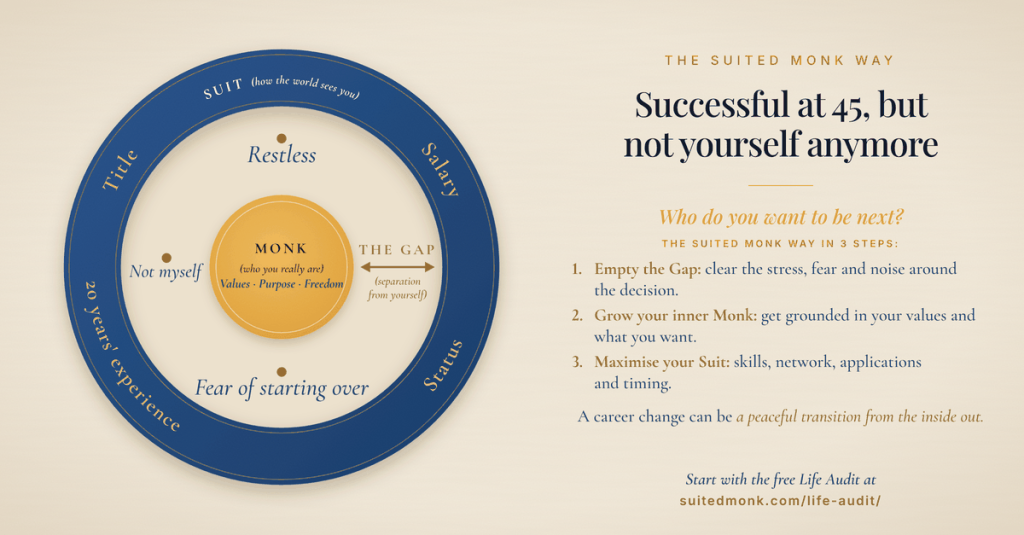
The way I run it through the Suited Monk philosophy:
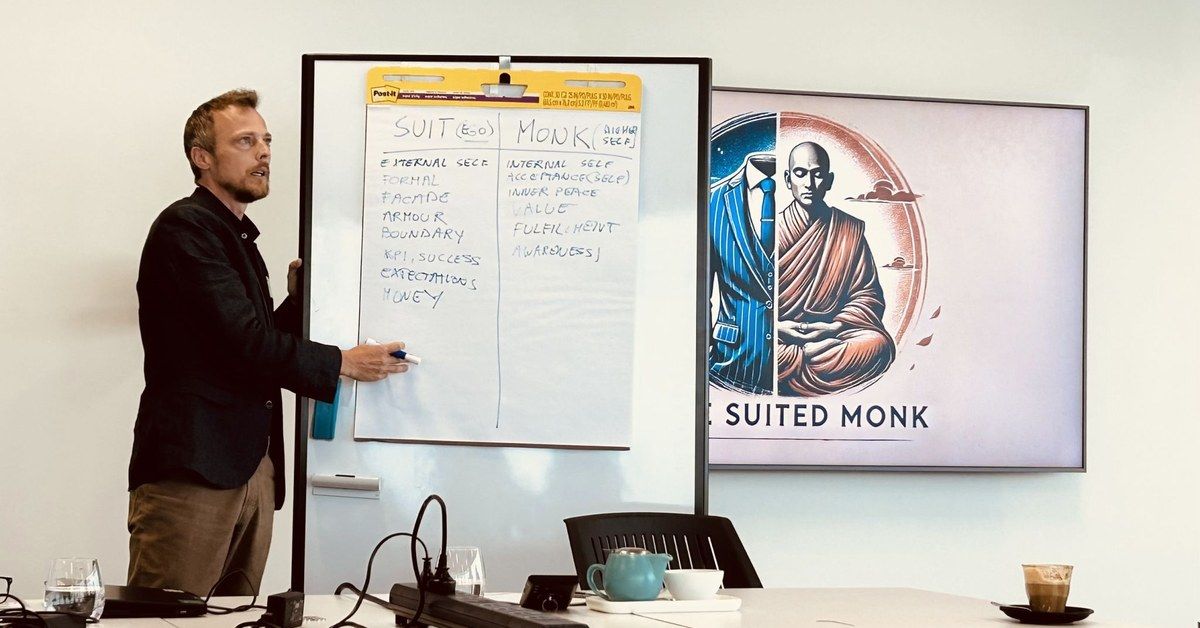
- The Suit is your outer life: role, title, results.
- The Monk is your inner life: what you value, your purpose, meaning and intuition.
- The Gap is the distance between them. If that gap is large, there is more stress and anxiety. If it is small, a person is more at peace while pursuing a good career.
At 45, many people feel that Gap for the first time, and a career change is one way to close it.
In my coaching I use a simple order:
- Empty the Gap: clear the stress, fear and noise around the decision.
- Grow your inner Monk: get grounded in your values and what you really want from your life.
- Maximise your Suit: do the outer work, such as skills, network, applications and timing.
That’s how a career change becomes a peaceful transition from the inside out rather than another escape. When a person is at peace with who they are, the outer decisions get a lot easier.
I’ve rebuilt my life twice more since 2008. In 2018 I moved from China to Spain with no Spanish, no clients and only my previous income, and in 2024 I moved from Spain to Sydney. Each time the lesson was the same: settle the inside first, follow my inner Monk and get clear on what matters in my life.
In life I let my outer journey always be an expression of my inner journey, not the other way around.
So if you’re considering a transition, always listen to your inner self first.
Related reading: career change at 50 in Australia and quitting a corporate job at 40.
A bit about me
I’m Raf Adams, a Sydney-based coach and the author of The Suited Monk. I have 20+ years in global business and 5,000+ hours of coaching leaders. I’m certified through the International Coach Academy, an ICF-accredited program. Right now my inner and outer worlds are aligned as one. I am at peace and enjoy my work in the external world.
A simple first step
Before you change anything, get an honest picture of where you are now. The free Life Audit takes about 3 minutes and shows which parts of your life feel aligned and which don’t: www.suitedmonk.com/life-audit
If you knew you had 20 good working years left, what would you want them to be about?