Don’t quit in a panic, and don’t stay on autopilot either. First work out what you actually hate and what the money is really buying you, then make a dated plan your numbers can carry. Often the real problem isn’t the job or the pay, it’s the Gap between how you earn your living and who you are.
I hear this a lot from capable, well-paid people who dread Monday and feel guilty for complaining. If that’s you, here’s how I’d think it through.
Who this is for
I’m writing for mid-career professionals and leaders, often in their 40s or 50s, with a solid career and a lifestyle to match. You’re not underpaid. You just feel you’re trading too much of your life for the pay slip.
If your job is unsafe or making you unwell, look after your health first and talk to your GP. Everything below assumes the job is draining, not dangerous.
Why a good salary makes it so hard to leave
A bad job that pays badly is easy to leave. A bad job that pays well is a trap with nice furniture. People call it the golden handcuffs, and I reckon there are three locks on them.
- The lifestyle lock. The mortgage, the school fees, the car and the holidays grew with the salary. Now the salary has to stay so the life can stay.
- The identity lock. The title tells you, and everyone else, that you’re doing well. Leaving feels like admitting you got it wrong.
- The fear lock. You’re not sure you could earn this elsewhere, so you never test it.
Professor Chris Jackson from the University of Sydney Business School put it well in an ABC News piece on people who are good at work they don’t enjoy: “People get stuck in a rut, and until they have some sort of shock, they can often stay in jobs they don’t like or find stressful for decades.”
Heading into 2027, with AI changing roles and restructures in the news, a “safe” salary may not be as safe as it looks. One more reason to plan rather than wait for the shock.
A bad job that pays well is a trap with nice furniture.
The shock that made the choice for me
I arrived in South China in 2006, aged 27, working in freight forwarding in Shenzhen on a Hong Kong contract. I threw myself at the Suit: title, results, money, how I looked to the people around me. Within two years I was one of the top sales performers in the region, with a contract in my hand for a European sales director role.
Then, in 2008, just before the financial crisis hit, I was fired. I sat in a coffee shop in Hong Kong, half relieved and half terrified. The job was gone. The title was gone. I walked to the beach and asked myself what I actually wanted. I had no idea.
That was my wake-up call. Looking back, the money and the title had been covering the Gap for a long time. The firing didn’t create the emptiness. It just stopped covering it.
I started my own business in 2010, and 2011 was a real turning point on the inside. Since then I’ve spent 14 years running my own training business in China and Spain, and now I coach leaders from Sydney. I’d rather you choose your moment than wait for one to choose you.
What do you actually hate?
“I hate my job” is too big to act on. Usually it’s one or two of these:
- The work itself. The tasks bore you or go against what you care about.
- The people. One boss, one board, one culture that wears you down.
- The load. The hours, the pressure, the phone that never switches off.
- The meaning. You can do the job well and still not care whether it gets done.
A simple test: imagine they doubled your pay tomorrow. If the feeling would fade, it’s probably money or recognition. If it wouldn’t, it’s deeper. The first three can often be fixed inside the job. The fourth usually can’t. I’ve written more on that in why you can feel unfulfilled in your job.
The Gap underneath the pay slip
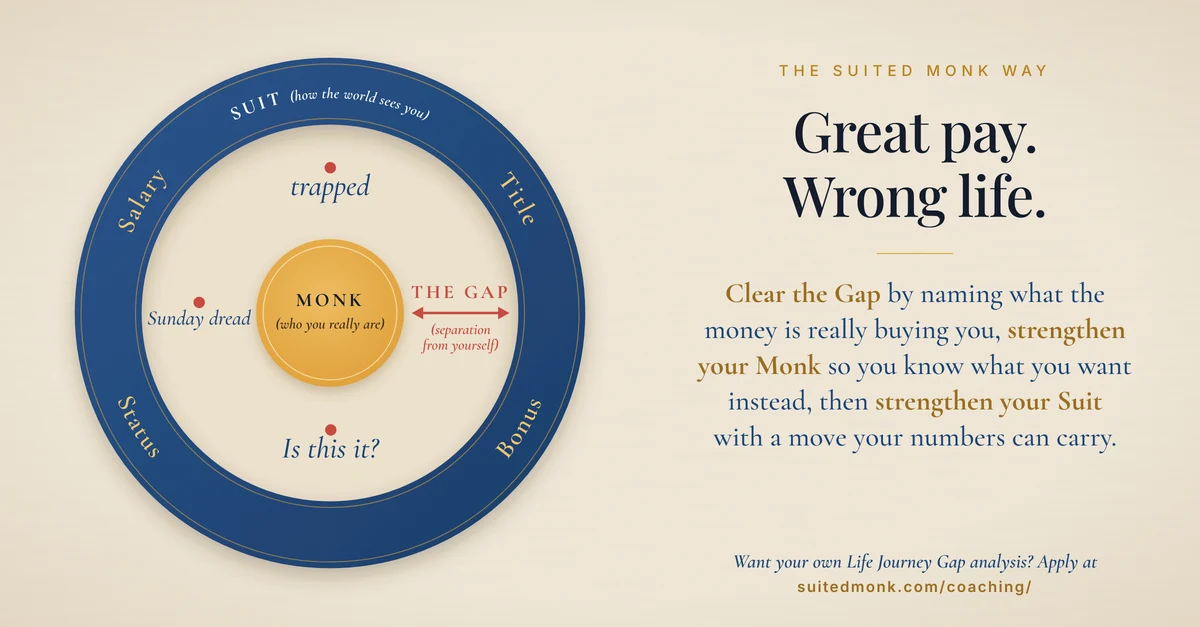
In The Suited Monk philosophy by Raf Adams, the Suit is your outer life: role, title, salary, status. The Monk is your inner life: your values, your purpose, who you are when nobody is grading you. The distance between them is the Gap.
A big salary makes the Suit thick, but it doesn’t grow the Monk. That’s why a pay rise feels great for a month and then the old feeling comes back. More money can’t fill a Gap that was never about money, the same way you can feel empty even though you’re successful.
The path I use has three steps, in this order. Clean the Gap: name what you’re carrying, including the fears that keep you in the job. Grow your Monk: get clear on who you are. Maximise your Suit: then shape the career and income around that. Happiness gets added on top of inner peace, not chased first. I explain why in from happiness to inner peace.
A big salary makes the Suit thick. It doesn’t make the Monk any bigger.
What is the money really buying you?
Most people in golden handcuffs know their salary but not their real number: what life costs once the stress spending is gone, like the takeaway because you’re too tired to cook and the holidays you need just to recover.
Try the free Moneysmart budget planner from the Australian Government. Then write two numbers down: what you need to live well, and what you need to feel safe. The difference between those and your salary is your real room to move. If the numbers are complicated, talk to a licensed financial adviser first.

Stay, reshape or leave: three honest options
1. Stay on purpose. Sometimes staying is smart: a debt to clear, a buffer to build. Give it an end date and a reason, and write both down. Staying by choice feels very different from staying by default.
2. Reshape the job. If the problem is the people or the load, a different team or a firm boundary might be enough. Ask before you assume no.
3. Leave with a plan. If the problem is the meaning, test the next direction while the salary is still coming in. If you’re weighing a bigger exit, read what to decide before quitting a corporate job at 40, and think about which skills will still matter, like the skill AI can’t replace in 2027.
Whichever you choose, choose it. The worst option is the kinda half-life where you stay, resent it, and tell yourself you’ll decide next year.
Frequently asked questions
I hate my job but it pays well. What should I do?
Don’t quit in a panic, and don’t stay on autopilot either. First work out what you actually hate and what the money is really buying you, then make a dated plan your numbers can carry. Often the real problem isn’t the job or the pay, it’s the Gap between how you earn your living and who you are.
Should I stay in a job I hate for the money?
Staying can be the right call for a while, if you stay on purpose. Pick an end date, name what the money is for and use the time to test what’s next. Staying with no date and no plan is how a year turns into ten.
Is it worth taking a pay cut to be happier?
It can be, but a pay cut alone rarely makes anyone happier. Work out what your life really costs first, then test the new direction before you leave. In my experience, people who move towards something they’ve tried cope with the drop in pay far better than people who are only running away.
How do I get out of golden handcuffs?
Loosen them one link at a time. Know your real number, build a buffer, cut the costs that only soothe a job you dislike, and start testing the next thing while the salary is still coming in. The handcuffs are usually part money and part identity, so work on both.
A starting point
You don’t need to resign this week. You need to see where the Gap is. The free online Life Audit takes about 3 minutes: 35 short statements, and you get your Suit, Monk and Gap scores by email. If you want help turning that into a plan, that’s what my career transition coaching is for.
The salary got you a good life on paper. I reckon you deserve one that also feels like yours.