A therapist helps you heal and treat what’s hurting you, like anxiety, depression, trauma or grief that won’t shift. A life coach helps when you’re basically well but stuck, restless or facing a big decision about your life or career. If you’re not sure, or you’re struggling to get through the day, start with your GP or a psychologist, and add coaching later or alongside.
Leaders ask me this more than you’d think, usually a bit embarrassed: “Do I need therapy, or do I need a coach?” I’m a coach, not a psychologist, so I’ll be upfront about where I fit and where I don’t.
Who this is for
I’m writing for business leaders, often in their 40s or 50s, who look fine from the outside. The career works. The pay is good. But something inside feels heavy, flat or restless, and you’re starting to wonder who to talk to.
If you’re in crisis or thinking about harming yourself, please don’t read on. Call Triple Zero (000) or Lifeline on 13 11 14, any time, day or night.
The real difference, in plain words
- What it’s for. Therapy treats and heals: mental health conditions, trauma, grief, patterns that keep hurting you. Coaching helps you get clear and move: decisions, direction, how you lead and how you live.
- Where it looks. Therapy often spends real time on the past and how it shows up now. Coaching starts from where you are and looks at what’s next, though a good coach won’t pretend the past doesn’t exist.
- Who’s regulated. In Australia, “psychologist” is a protected title. Psychologists are registered with the Psychology Board of Australia, and you can check anyone on the AHPRA public register. “Therapist”, “counsellor” and “coach” aren’t protected titles, so training varies a lot.
- How it’s paid for. If your GP diagnoses a mental health condition, a mental health treatment plan can get you a Medicare rebate on sessions with a psychologist. Coaching isn’t a health service, so there’s no Medicare rebate. You pay for it yourself, or your employer does.
Ask yourself one thing: am I struggling to function, or struggling to choose?
Signs you need a therapist first
Start with your GP or a psychologist if any of these have been true for a few weeks or more:
- Your mood is low most days, and things you used to enjoy feel pointless.
- Your sleep, appetite or energy has changed and isn’t bouncing back.
- Worry or panic is hard to switch off and is getting in the way of work or home.
- Something from your past, like a loss or a trauma, keeps dragging you back.
- You’re exhausted, more cynical than you used to be, and getting less done no matter how hard you push.
That last one can look like burnout. Get checked by your GP first. Once your doctor’s happy, coaching can help with what comes next, which is what my executive burnout coaching is built around.
Signs a coach is the better fit
A coach is usually the right call when you’re coping, even performing well, but something doesn’t add up:
- You hit a big goal and felt relief instead of joy.
- You feel like you’re playing a role at work and at home.
- Your sense of worth rises and falls with external validation: the title, the bonus, the boss’s opinion.
- You’re weighing a career change, or a big “what now?”, and keep going round in circles.
If that sounds like you, it’s worth reading why you can feel empty even though you’re successful. It isn’t an illness. It’s information.
What I needed when my Suit fell off
In 2008, just before the financial crisis hit, I was fired. I’d spent two years in Shenzhen throwing myself at the Suit: title, results, money, how I looked to the people around me. Then I sat in a coffee shop in Hong Kong, half relieved and half terrified. The job was gone. The title was gone.
I walked to the beach and asked myself what I actually wanted. I had no idea. Looking back, I reckon what I was missing wasn’t treatment. It was a clear sense of who I was without the title. The firing didn’t create the emptiness. It just stopped covering it.
That search became my work. I’ve spent 14 years running my own training business in China and Spain, and now I coach leaders from Sydney. But if I’d been sinking rather than lost, the right first call would have been a doctor, not a coach. I’d tell any leader the same.
The Gap: where coaching and therapy meet
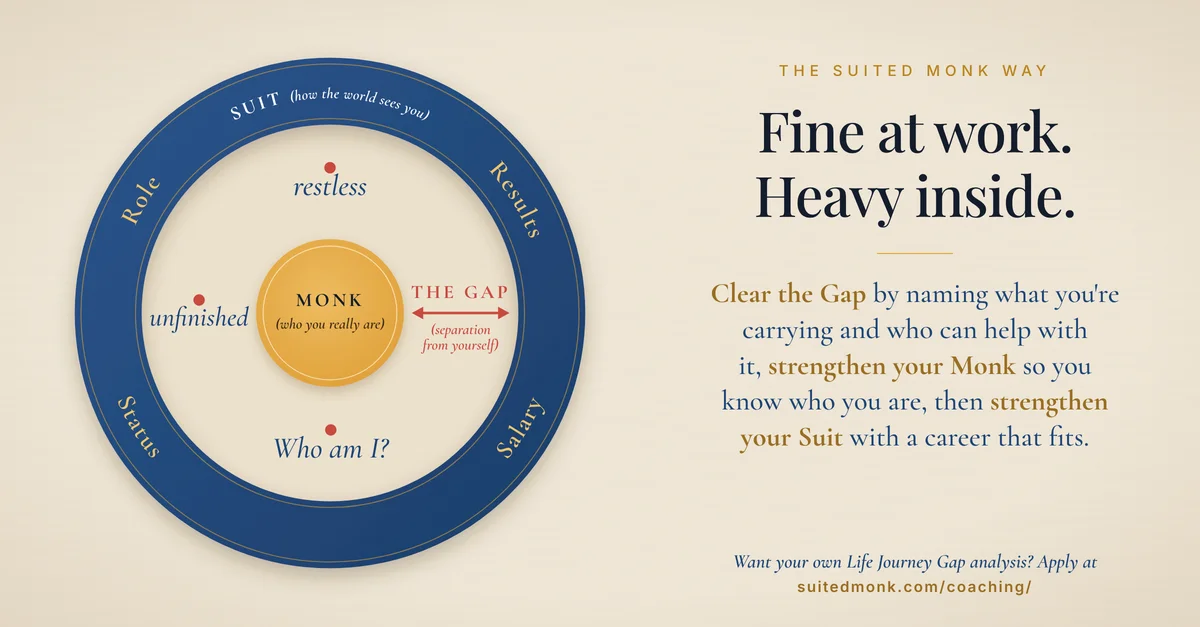
In The Suited Monk philosophy by Raf Adams, the Suit is your outer life: role, results, salary, status. The Monk is your inner life: your values, your purpose, who you are when nobody’s watching. The distance between them is the Gap.
The Suit usually isn’t the problem. Plenty of leaders have a great Suit. The problem is the Gap, and what’s piled up in it: old hurts, unfinished conversations, regrets, fears, a life built to impress.
Here’s the honest bit. If what’s in your Gap is trauma, deep grief or a mood that’s taking over, that’s therapy work, and a good coach will say so. A lot of what leaders carry, though, is unfinished business and questions about meaning. That’s where coaching helps.
The path I use has three steps, in this order. Clean the Gap: name what you’re carrying, and get the right help for each part of it. Grow your Monk: get clear on who you are, not just what you do. Maximise your Suit: then shape your career and leadership around that.
The Suit usually isn’t the problem. The problem is the Gap.
Can you see both?
Yes. I reckon it’s often the smartest option. A therapist helps you heal what’s underneath. A coach helps you decide what to build on top.

How to choose well in Australia
- Describe it as a feeling, not a label. “I feel flat and can’t sleep” points one way. “I feel restless and don’t know what’s next” points another.
- Check the title. For a psychologist, look them up on the AHPRA register. For a coach, ask about their training, how many hours they’ve coached leaders and when they refer people on. I’m certified through the International Coach Academy, an ICF-accredited program, and I’ve done 5,000+ hours of coaching leaders, but ask any coach the same questions.
- Ask how they’d know it’s not working. Good ones have a clear answer.
- Trust the chemistry. You’ll be telling this person things you don’t tell your team. Kinda important that you like them.
Some leaders want a third option for questions of meaning and values. That’s philosophical counselling, and it sits between the two. If it’s a coach you need, here’s how my one-to-one coaching for leaders works, and what life coaching for executives in Sydney looks like with me.
Frequently asked questions
Life coach vs therapist: what’s the difference?
A therapist helps you heal and treat what’s hurting you, like anxiety, depression, trauma or grief that won’t shift. A life coach helps when you’re basically well but stuck, restless or facing a big decision about your life or career. If you’re not sure, or you’re struggling to get through the day, start with your GP or a psychologist, and add coaching later or alongside.
How do I know if I need a life coach or a therapist?
Ask yourself whether you’re struggling to function or struggling to choose. If your mood, sleep or ability to cope has changed and stayed changed, see your GP or a psychologist. If you’re coping fine but feel restless, empty or stuck at a crossroads, a coach is usually the better fit.
Is a life coach the same as a therapist?
No. In Australia, psychologist is a protected title and psychologists are registered through AHPRA, while anyone can call themselves a life coach. A good coach doesn’t diagnose or treat mental health conditions, and should refer you on when something is outside their lane.
Can I see a life coach and a therapist at the same time?
Yes, and plenty of people do. Let your therapist lead on your health, use your coach for decisions and direction, and tell each of them about the other so they’re not pulling you in different ways.
A starting point
If you’re coping but something feels off, start by seeing where the Gap is. The free online Life Audit takes about 3 minutes: 35 short statements, and you get your Suit, Monk and Gap scores by email. It isn’t a mental health check, so if you’re struggling, see your GP too.
Whoever you choose, choosing to get help is already a good sign. You’re worth looking after, not because of what you do, but because of who you are.