Is life pointless? If you’re asking that, I want to say something first. You’re not broken, and you’re not the only one.
Over the past 10+ years of running workshops, coaching people one-on-one and hearing from readers of my books, almost everyone has told me about a low point where this exact question came up. I’ve had mine too.
So let’s talk about it honestly. Not with a pep talk, but with what I’ve actually seen help.
If you’re in a really dark place right now, please reach out. In Australia you can call Lifeline on 13 11 14, any time, day or night.
In short
Life often feels pointless not because it is, but because there’s a gap between how you’re living and who you actually are. Ticking more boxes rarely fixes it. Letting yourself feel it, noticing what still moves you and taking one small aligned step is what I’ve seen help, again and again.

Why Does Life Feel Pointless?
It usually doesn’t arrive all at once. It creeps in.
You wake up and the day already feels heavy. You do the things, tick the boxes, answer the emails. And underneath there’s this flatness, like someone turned the colour down on everything. Or there’s a restlessness that won’t settle, no matter how busy you keep yourself.
Sometimes it follows something big: a job loss, a breakup, a health scare, someone dying. The ground shifts, and the old reasons for getting up don’t hold anymore.
And sometimes, which surprises people, it shows up when life is going well. The promotion came. The house is nice. And you think, “Is this it?”
I reckon that second one is the most confusing. You did everything you were told would make you happy. So why does it feel empty?
Is Life Meaningless, or Are You Misaligned?
Here’s what I’ve come to believe after years of sitting with people in this place.
A lot of the time, life doesn’t feel pointless because life is pointless. It feels pointless because there’s a gap between how you’re living and who you actually are.
I call it the Gap. On one side is your inner self: what you value, what moves you, what feels true. On the other side is the life you’ve built, often around external validation. The title, the salary, what people think, what looks good.
When those two drift apart, something in you notices. It might not have words for it. It just goes flat. Kinda like an engine running in the wrong gear: lots of noise, not much moving.
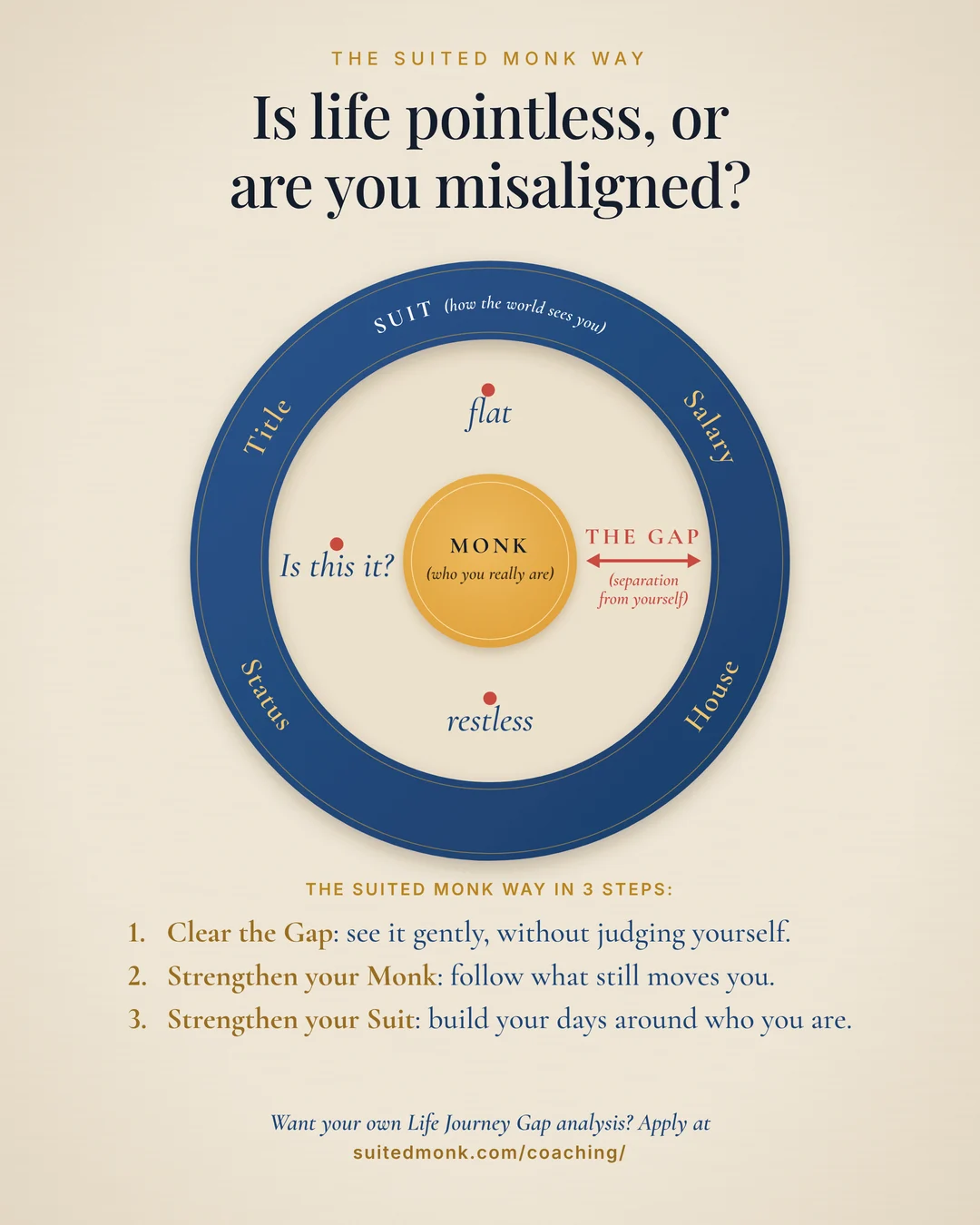
That’s why ticking more boxes rarely fixes it. If the boxes were someone else’s, adding more just makes the Gap wider.
And here’s the bit I wish someone had told me earlier. Your worth doesn’t come from what you do. It comes from who you are. You’re not worth more on a productive day and less on a flat one. When that lands, even a little, the question “what’s the point?” starts to shift.
Your worth doesn’t come from what you do. It comes from who you are.
Viktor Frankl put it beautifully in Man’s Search for Meaning:
“Life is not primarily a quest for pleasure, as Freud believed, or a quest for power, as Alfred Adler taught, but a quest for meaning. The greatest task for any person is to find meaning in his or her own life.”
Meaning isn’t something you’re handed. It’s something you find, usually by moving back towards yourself.
If you’re wondering how wide your own Gap is, the free Life Audit can show you. It’s 35 statements, takes about 3 minutes, and gives you a free personal report.
What to Do When Life Feels Pointless
There’s no five-minute fix here, and I won’t pretend there is. But these are the things I’ve seen help, again and again.
Let yourself feel it
This one sounds backwards. When life feels pointless, most of us try to push the feeling away, by staying busy, scrolling, or doing one more thing.
But sometimes we don’t need to produce anything. We just need to be. Sad days and good days are both part of being human. Letting the heaviness be there, without judging yourself for it, often takes some of its weight away.
Embracing the feeling that life seems pointless can actually be the start of feeling free.
Notice what still moves you, even a little
You don’t need a grand purpose. Start smaller.
What made you lose track of time as a kid? When did you last feel even a flicker of interest, or peace, or joy? A walk, a song, a conversation, cooking for someone?
Those flickers are clues. They point towards who you are underneath the roles. Do a bit more of whatever they are, not to be productive, just because they’re yours.
Talk to someone who’s been there
Here’s the thing: pretty much everyone has been there. Your friends, your parents, that colleague who seems to have it all sorted.
Ask them. “Have you ever felt like this? What helped?” You might be surprised how honest people get when you go first. And it reminds you that this feeling is part of being human, not proof that something’s wrong with you.
Look at the Gap, gently
Grab a notebook and draw two columns. On the left, write what matters to you, what you value, the kind of person you want to be. On the right, write how your days actually go.
Where do they match? Where are they miles apart?
Don’t try to fix it all at once. Just see it. Seeing the Gap clearly is often the moment things start to move.
Take one small aligned step
Pick one thing from the left column and give it an hour this week. One honest conversation. One morning doing something for its own sake. One “no” to something that drains you.
Small steps are how the Gap closes. And as it closes, inner peace tends to show up, not because you chased it, but because you stopped running away from yourself.
Maybe it’s not the end of the road. Maybe it’s an invitation to come back to yourself.
When to Get Support
Feeling like life is pointless now and then is very human. But if it hangs around for weeks, if it’s getting heavier, or if you’re having thoughts of hurting yourself, please don’t carry that on your own.
Talk to your GP or a mental health professional. In Australia, Lifeline is there 24/7 on 13 11 14. If you’re in immediate danger, call 000.
There’s no shame in that. Reaching out is one of the most aligned things you can do.
If you’re not in crisis but you feel stuck, lost or flat, that’s where my work comes in. Philosophical counselling and coaching aren’t therapy. They’re a space to look at the big questions, what matters, who you are, how you want to live, with someone walking beside you. You can read more about philosophical counselling here, or work with me one-on-one.
A Final Thought

In philosophy, the point of life has often been described as a journey towards self-realisation, towards becoming more fully who you are. That’s what practical philosophy is about.
I reckon the low points are part of that journey, not a detour from it. Through loss, pain and that flat “what’s the point?” feeling, we learn things about ourselves we couldn’t learn any other way. That awareness is how we grow.
So if life feels pointless right now, maybe it’s not the end of the road. Maybe it’s an invitation to come back to yourself.
And if you’d like to go further, I wrote about the Gap in The Suited Monk and Suited Monk Leadership. Or, if you feel lost about direction more than meaning, start with how to find your path in life.
Frequently Asked Questions
Where is your Gap today? The free Life Audit takes a few minutes and shows you your Suit, Monk and Gap scores.
About the Author
Raf Adams has been helping people align their internal and external self and find their path in work and life. Originally from Belgium, he has lived in China for 12 years, Spain for 6 years and now Australia for almost 3 years, delivering workshops and seminars for companies, and is the author of The Suited Monk and Suited Monk Leadership.
Want to learn more about the Suited Monk? Click here to get one of Raf’s books